
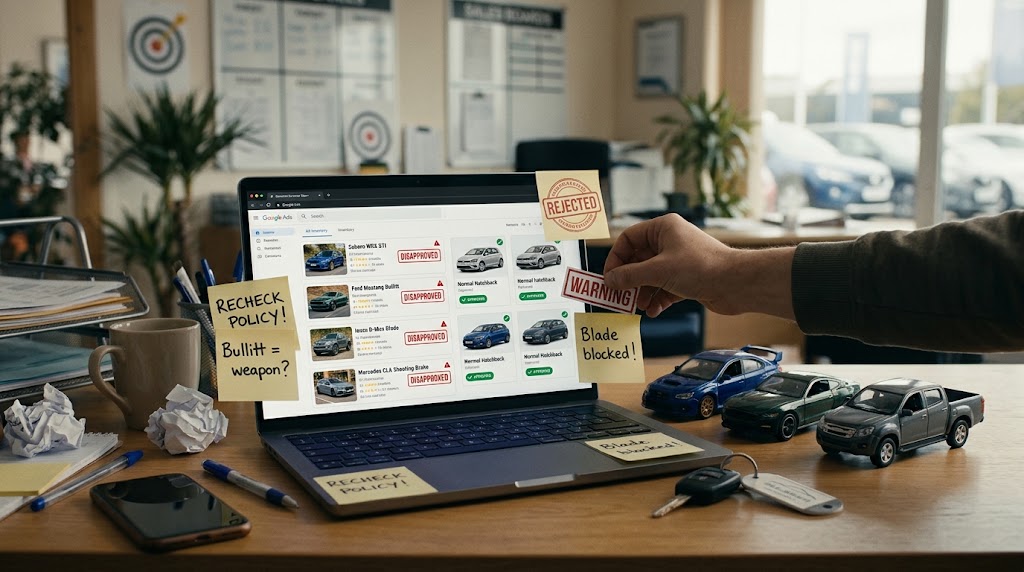
Anyone who has run Google Ads for a car dealership knows the feeling. The stock is uploaded, the ads are written, everything looks perfect, and then a red “Disapproved” label appears next to a perfectly ordinary used hatchback.
Google checks billions of ads using automated systems, and those systems read words, not context. To a machine, a “1.0 Semi-Automatic in Gunmetal Grey” can look less like a sensible family runaround and more like an arms deal.
Here are some of the car terms that can make Google’s filters nervous.
The usual suspects
1. “Semi-Automatic”
To a car buyer, it’s a gearbox. To Google’s weapons policy, it’s something else entirely. We’ve seen ads blocked simply because the transmission type was in the title.
2. “Gunmetal Grey”
A popular and very respectable paint colour. Unfortunately, it starts with “gun”. A metallic grey Fiesta has never hurt anyone, but the filters don’t always know that.
3. “Shooting Brake”
A stylish body shape that is part estate, part coupé, as seen on the Mercedes CLA Shooting Brake. It’s a name that dates back to vehicles used on hunting trips, which doesn’t help its case with a weapons filter.
4. “Blade”
The Isuzu D-Max Blade is a pickup truck, not a kitchen knife. Words linked to bladed weapons are exactly what automated checks are trained to look for.
5. “Bullitt”
The Ford Mustang Bullitt is named after a classic Steve McQueen film. One letter away from ammunition is close enough to raise an eyebrow.
6. “STI”
For Subaru fans, STI means a rally-bred Impreza or WRX. In Google’s health policies, those three letters mean something quite different.
7. “Killer deals” and “explosive performance”
It’s not just model names. Enthusiastic ad copy can also trip the filters. Violent or dangerous-sounding phrases are best kept out of the sales patter.
8. “White BMW”
A clean, classic choice on any forecourt. But “white” is also street slang for a certain illegal powder, and Google’s drug filters don’t always know you’re talking about Alpine White paintwork. Pair it with a few other unlucky words and a perfectly innocent 3 Series can end up looking like it’s dealing in more than cars.
9. “Fully loaded”
Every dealer’s favourite way to describe a car with all the extras. Unfortunately, “loaded” also sounds like a weapon ready to fire, or someone who’s had one too many. Heated seats have never been so suspicious.
10. “High spec” and “high mileage”
Perfectly normal car-buying language, but “high” is one of those words drug filters keep a close eye on. A high-spec diesel estate is about as rock ‘n’ roll as it gets on most forecourts.
11. “Kia Stinger”
A smart sports saloon, and also the name of a well-known missile. Add “GT” and “launch control” to the ad, and you can see how a nervous filter might get the wrong idea.
12. “Tobacco leather”
A rich brown interior colour found in some premium cars. Google has strict rules on tobacco products, and a filter can’t smell the difference between a Range Rover and a packet of cigarettes.
13. “Fuel injection”
Under the bonnet, it’s what makes the engine run smoothly. In Google’s eyes, “injection” belongs firmly in healthcare and medicine, where the rules are much tighter.
14. “Nitro”
Whether it’s the Dodge Nitro or a car described as having nitro-like acceleration, words that sound like explosives can make any automated system twitchy.
Why does this happen?
Not every one of these gets flagged every time. Google’s systems change constantly. But they are the kind of words that make automated reviewers twitch.
Google has strict rules on weapons, healthcare, adult content and other sensitive subjects. With so many ads to check, most of the first review is done by machines that scan for risky words. They err on the side of caution, and the motor trade is full of words that mean something else outside the showroom.
This matters more for dealers than most. Vehicle titles often come straight from your stock feed, so a single colour or gearbox description can quietly block ads for several cars at once.
What we do about it
- Check disapprovals daily. A blocked ad for a car on your forecourt is a missed enquiry, so we keep an eye on ad status rather than waiting for a drop in calls.
- Appeal where it’s clearly a mistake. Google lets advertisers request a review. Once the context is clear, many of these are resolved.
- Reword where it costs nothing. “Dark Grey Metallic” sells a car just as well as “Gunmetal Grey” in an ad, and the full spec can stay on your website.
- Fix it at the source. Where a word in your stock feed keeps causing problems, we can adjust how it appears in your ads so the issue doesn’t come back with every new car.
The bottom line
Automated checks keep Google Ads safe, but they don’t always understand cars. The good news is that these problems are easy to fix once they’re spotted, and spotting them is part of our job.
So rest assured: we know your semi-automatic estate isn’t a weapon, even if Google needs a little convincing.